
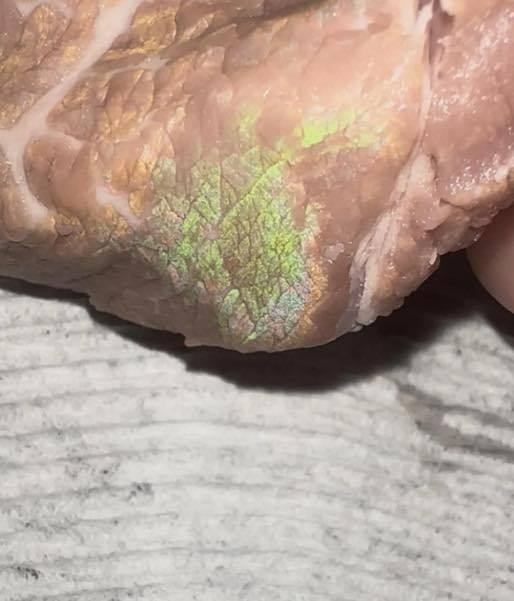
And suddenly stop.
Because instead of rich brown or pink, the surface shimmers with iridescent streaks of green, purple, and blue — like oil on pavement or a soap bubble.
Is it spoiled?
Is it unsafe?
Did my lunch meat turn into a disco ball?
Relax — this colorful effect is actually completely normal.
Let’s explore why some meats look rainbow-colored, when it’s safe, and when it might be time to toss that package.
Spoiler: Your meat isn’t magic.
But physics?
Now that is pretty cool.
 What Causes the Rainbow Effect on Meat?
The shimmer you’re seeing is called iridescence — and it has nothing to do with spoilage or dyes.
It’s caused by a natural phenomenon known as light diffraction.
Here’s how it works:
1. Muscle Fibers Are Packed in Patterns
When meat is sliced, especially against the grain, the cut exposes tightly bundled muscle fibers
These fibers are arranged in neat, parallel rows — like tiny grooves on a record
2. Light Bounces Off the Surface
When light hits these microscopic ridges, it bends (diffracts) at different angles
Just like a prism splits white light into colors, the structured muscle surface separates light into its spectrum
 This creates a rainbow-like sheen — especially under fluorescent or LED lighting.
 Think of it like the rainbow you see on a CD or DVD — same principle!
Is Rainbow-Colored Meat Safe to Eat?
Yes — in most cases, iridescent meat is perfectly safe.
Shiny, rainbow tint on surface
Likely light diffraction — harmless
Smooth texture, no slime
Good sign of freshness
Mild or neutral smell
Not spoiled
 If all of the above apply, go ahead and enjoy your sandwich.
 When to Be Concerned: Spoilage Signs
Rainbow hues alone don’t mean danger — but combine them with other red flags, and it’s time to toss it.
Read more on the next page
ADVERTISEMENT
ADVERTISEMENT

