
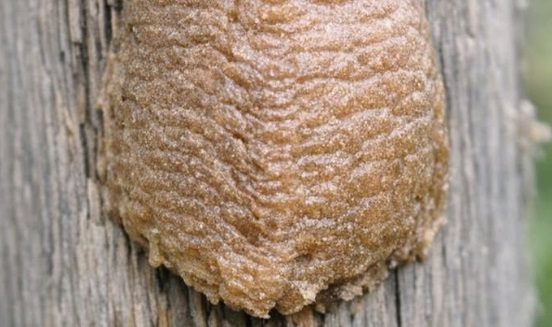
You won’t just find these on fence posts. Mantises are very strategic about where they leave their young. You might find an ootheca:
Tucked inside thick shrubs or hedges.
Attached to the sturdy stems of tall weeds or flowers.
On the underside of garden furniture or wooden railings.
They choose these spots because they are usually hidden from predators but close enough to the ground so the babies can find food easily once they hatch.
5. Why You Should Not Scrape It Off
It might be tempting to clean up your fence post, but it is much better to leave the egg case alone. These structures are completely harmless to humans, pets, and your property. They don’t cause rot in wood and they don’t attract dangerous pests.
When you “hesitated” to scrape it off, you did the right thing! Removing it often kills the hundreds of tiny mantises inside. By letting it stay, you are supporting the local ecosystem and ensuring your garden stays healthy and balanced.
6. Hundreds of Tiny Hunters
Inside that single brown structure, there are often 100 to 400 eggs waiting for the right moment. They stay in a state of rest all winter long. As the sun gets warmer in the spring, the embryos finish developing.
When it is finally time, the babies (called nymphs) emerge all at once. They look like microscopic versions of their parents. Even though they are tiny, they are born with the instinct to hunt. They immediately spread out across your yard to look for small pests to eat.
7. The Magic of Spring Hatching
Watching a mantis egg case hatch is a amazing sight. It usually happens in mid-to-late spring when other insects, like aphids, are also starting to appear. This ensures the babies have plenty of food to help them grow.
You might see dozens of tiny, pale insects spilling out of the ridges of the ootheca. They are very fragile at first, but they quickly darken in color and disappear into the leaves of your garden.
8. Moving the Case Safely
Sometimes, an egg case is in a bad spot—maybe you are planning to paint your fence or move a piece of furniture. If you must move it, you can do so safely without hurting the babies.
You can gently use a knife to pop the case off the surface, or if it’s on a twig, just snip the twig off. You can then move it to a bushy area of your yard. Use a little bit of wire or string to attach it to a branch, making sure the side that was originally “up” stays facing upward.
9. Understanding the Difference
It is easy to get confused by all the different shapes in nature. Here is how to tell a mantis ootheca apart from other things:
Wasp Nests: These are usually gray, feel like paper, and have visible holes or a “honeycomb” look.
Fungus: This is usually softer, may feel slimy, and doesn’t have the organized ridges of a mantis case.
Mantis Case: This is tan or brown, feels like hard “Styrofoam,” and is firmly glued to a surface.
10. A Natural Science Lesson
Finding a structure like this is a great chance to learn more about the world around you. Instead of seeing it as “gross” or “weird,” think of it as a front-row seat to a nature documentary happening right in your backyard.
Keeping an eye on the case over the weeks and months can be a fun way to connect with the seasons. It reminds us that even a simple fence post can be a home for the next generation of helpful garden creatures.
ADVERTISEMENT

