
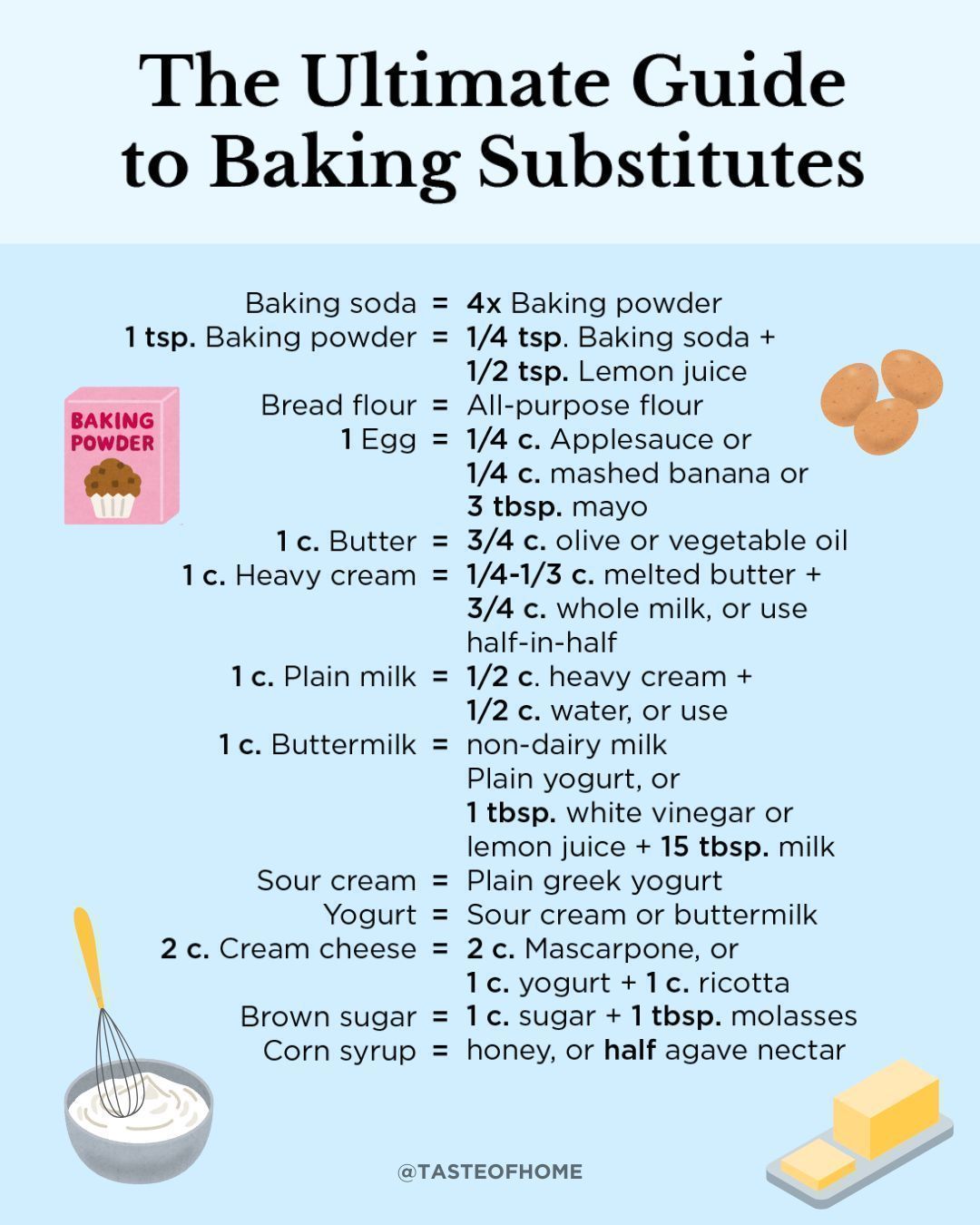
Baking can seem like an impossibly precise science, but there’s a little wiggle room when you’re missing a key ingredient. Use these easy baking substitutes to save your batter—and the day.
The bake sale is tomorrow morning and the grocery store is already closed. You signed up to bring the banana bread but there’s not a drop of buttermilk in the house! Don’t abandon your bowl—reach for one of these simple baking substitutions to keep your mixer humming.
Here are the baking substitutes you can use in a pinch—and how to make it all work.
Baking Soda Substitutes
Baking powder. Use four times the amount of baking soda your recipe calls for and you’ll be set. While baking soda needs an acid to rise, baking powder already contains its own acid (cream of tartar), so you might want to reduce or swap out another acidic ingredient, such as lemon juice or buttermilk, in your recipe.
Potassium bicarbonate. It’s less common in today’s pantry, but you can use it in a 1:1 ratio to baking soda. Since it doesn’t contain sodium, you may want to add an extra pinch of salt to your recipe.
Self-rising flour. While it’s not appropriate for all recipes, this flour already contains baking powder and salt (about 1-1/2 teaspoon and 1/4 teaspoon, respectively, per cup of flour).
This is the difference between baking soda and baking powder.
Baking Powder Substitutes
Cream of tartar. Use 1/4 teaspoon baking soda, 1/2 teaspoon cream of tartar and 1/4 teaspoon cornstarch as a substitute for 1 teaspoon baking powder.
Lemon juice. Use 1/4 teaspoon baking soda for each 1 teaspoon baking powder your recipe calls for, and add 1/2 teaspoon lemon juice to the wet ingredients. The acid in the juice will create the reaction your goodies need to puff up.
Club soda. No baking soda on hand, either? If your recipe doesn’t require a lot of rising (like pancakes), replace the liquid in your recipe with club soda.
Baking powder is actually a combination of baking soda and cream of tartar—this is what cream of tartar actually is.
Flour Substitutes
Cake Flour Substitutes
Cornstarch. Cake flour produces a tender crumb because its protein content (and therefore gluten development) is lower than all-purpose flour’s. Remove 2 tablespoons of all-purpose flour per 1 cup and replace with 2 tablespoons cornstarch, sifting several times to combine.
All-purpose flour. If you’re out of cornstarch, too, simply omit it. Just remove 2 tablespoons per 1 cup of all-purpose flour to reduce the protein (and chewy gluten!) in your recipe.
Here’s when and how to use each kind of flour.
Bread Flour Substitute
All-purpose flour. Bread flour has a higher protein content than all-purpose and cake flour, which results in a chewier texture that works well with a yeast rise. But all-purpose flour can accomplish similar results—no harm done. Just swap it in cup for cup.
Self-Rising Flour Substitute
All-purpose flour + baking powder + salt. If your recipe calls for self-rising flour, you can easily make your own instead of rushing to the store. Simply combine 1 cup all-purpose flour, 1-1/2 teaspoons baking powder and 1/4 teaspoon salt. Easy-peasy! Learn more about self-rising flour.
Egg Substitutes
Applesauce. Swap in 1/4 cup applesauce per egg. Unsweetened applesauce works best. If you only have the sweetened kind, consider reducing some of the sugar in your recipe.
Bananas. If a little banana flavor won’t throw off your finished product, use 1/4 cup mashed banana per egg.
Mayonnaise. It’s loaded with eggs, so simply use 3 tablespoons of mayo for every egg.
Butter Substitutes
Margarine. Butter’s partner-in-crime, margarine, works well as a substitute in many recipes. Go ahead and swap equal amounts.
Shortening. A classic from grandma’s kitchen, shortening can also be swapped 1:1 for butter. You may want to boost up your flavoring agents, like salt and extracts, though, as shortening doesn’t have much flavor.
Oil. Olive, coconut and vegetable oils can all be used as a butter substitute. These swaps work best in more liquid batters—like cakes, quick breads or brownies. Add 3/4 cup of olive or vegetable oil for every cup of butter, or swap an equal amount of coconut oil.Heavy Cream Substitutes
Milk + butter. Heavy cream is, well, heavier than plain ol’ milk, so to make a substitute you need to add in some extra fat. That’s where butter comes in. Melt 1/4 to 1/3 cup butter, let it cool, then mix with 3/4 cup whole milk.
Coconut cream. For a dairy-free option, grab coconut cream. When chilled, this hearty canned ingredient yields a thick, solid cream that’s ideal for adding to tropical desserts.
Half-and-half. As its name implies, half-and-half combines milk and heavy cream, making it a worthy substitute. If desired, you can add a little cooled, melted butter for even more richness.
For more information, check out our guide to heavy cream substitutes.
Milk Substitutes
Plain Milk Substitutes
Nondairy milk. If you have almond, soy, cashew, oat or some other nondairy milk on hand, feel free to sub it in for dairy milk. You can swap it equally in your recipe, but be prepared for slight texture or flavor tweaks—nondairy milk (especially almond) typically has less fat and is not quite as creamy as regular milk.
Evaporated milk. Even if your fridge is empty, there’s a good chance evaporated milk is hiding in your cupboard. Use 1/2 cup evaporated milk mixed with 1/2 cup water for every cup of milk in your recipe.
Heavy cream or half-and-half. Since both of these products are already dairy-based, they make great milk substitutes. Use half-and-half at a 1:1 ratio, and dilute 1/2 cup heavy cream with 1/2 cup water for each cup of milk.
Here’s how to substitute milk when cooking and baking.
Milk Substitutes
Plain Milk Substitutes
Nondairy milk. If you have almond, soy, cashew, oat or some other nondairy milk on hand, feel free to sub it in for dairy milk. You can swap it equally in your recipe, but be prepared for slight texture or flavor tweaks—nondairy milk (especially almond) typically has less fat and is not quite as creamy as regular milk.
Evaporated milk. Even if your fridge is empty, there’s a good chance evaporated milk is hiding in your cupboard. Use 1/2 cup evaporated milk mixed with 1/2 cup water for every cup of milk in your recipe.
Heavy cream or half-and-half. Since both of these products are already dairy-based, they make great milk substitutes. Use half-and-half at a 1:1 ratio, and dilute 1/2 cup heavy cream with 1/2 cup water for each cup of milk.
Buttermilk Substitutes
White vinegar. The acidity of buttermilk not only adds tang to baked goods but it also helps break down gluten, keeping your texture on point. For each cup of buttermilk, substitute 1 tablespoon white vinegar or lemon juice plus enough milk to measure 1 cup.
Plain yogurt. Substitute in a 1:1 ratio. Simple!
Powdered buttermilk. OK, it’s still like having buttermilk, but this ingenious product has a much longer shelf life than the liquid stuff. Just mix the powder in with your dry ingredients and water in place of liquid buttermilk in with your wet ingredients.
Check out these easy ways to make a buttermilk substitute.
Evaporated Milk Substitutes
NEXT
ADVERTISEMENT

