
Nausea, vomiting, diarrhea
Stomach cramps
Headache
In severe cases: confusion, fever, hallucinations (extremely rare)
Who is most at risk: Children, elderly, and people with compromised immune systems may be more sensitive.
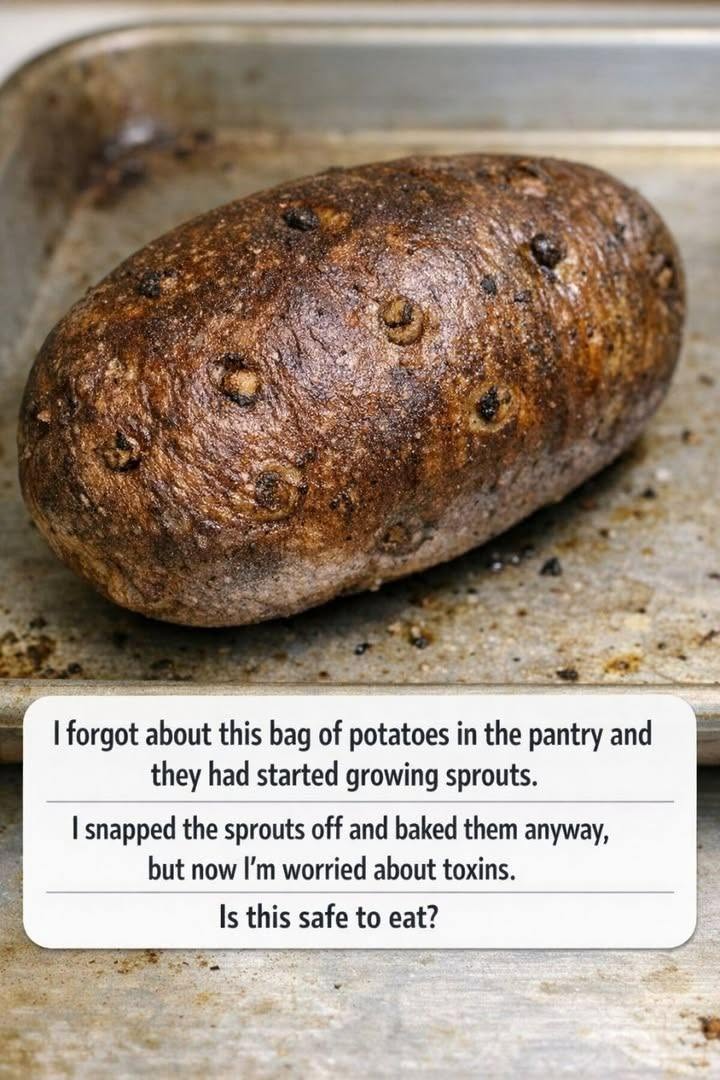
How much is dangerous? Solanine poisoning typically requires eating a large quantity of badly sprouted or green potatoes. A few small sprouts removed from an otherwise firm potato is not a concern.
The bottom line: Your body is good at detecting solanine. If a potato tastes bitter or causes a burning sensation in your mouth, stop eating it.
How to Safely Prepare Sprouted Potatoes (Step-by-Step)
Let me give you a clear, actionable guide.
Step 1: Inspect the Potato
Firm and solid? Good. Proceed.
Wrinkled, shriveled, or soft? Toss it. The potato has lost too much moisture and may have higher solanine levels.
Step 2: Remove the Sprouts
Use your fingers or a small knife to snap or cut off all sprouts. Dig out the “eyes” (the spots where the sprouts grew) as well—that’s where solanine is concentrated.
Step 3: Cut Away Green Spots
Any green patches on the skin or flesh should be cut off completely. The green color is chlorophyll, which indicates solanine is present.
Pro tip: If the potato is mostly green (large patches), toss the whole potato.
Step 4: Peel the Potato (Optional but Recommended)
Peeling removes the skin, where solanine is most concentrated. For sprouted potatoes, peeling is a good safety measure.
Step 5: Cook Thoroughly
Cooking does not destroy solanine. However, it does make the potato tastier and easier to digest. Boiling, baking, roasting, or frying are all fine.
Step 6: Taste Test
Take a small bite before eating a large portion. If the potato tastes bitter or causes a burning sensation on your tongue, stop eating and toss the batch.
see continuation on next page
ADVERTISEMENT
ADVERTISEMENT

